01 · The Perspective
Diagnosed, treated, counted, lost
The story below is illustrative, built from the gaps described in our sources. It is not about a real person.
Mallappa is 52 and works on other people's farms. An ASHA finds his blood pressure high at his doorstep, and the health centre gives him a month of tablets. For two months he goes back for refills.
After the harvest he leaves for construction work in Bengaluru, as he does most years. His tablets run out in the third week. Nobody in the city knows he is a patient. He feels fine, so he does not look for a pharmacy.
Four months later his reading is 168/100. The record still shows him as "on treatment". He was diagnosed, treated and counted. He was never kept.
02 · The Perspective
A national reach, a local leak
India's reach is real. The 75/25 initiative reported 4.20 crore people on hypertension treatment and 2.53 crore on diabetes treatment by March 2025, close to 90% of its target. Free protocol medicines are available at Ayushman Arogya Mandirs, and every state has adopted the India Hypertension Control Initiative (IHCI) treatment protocol.
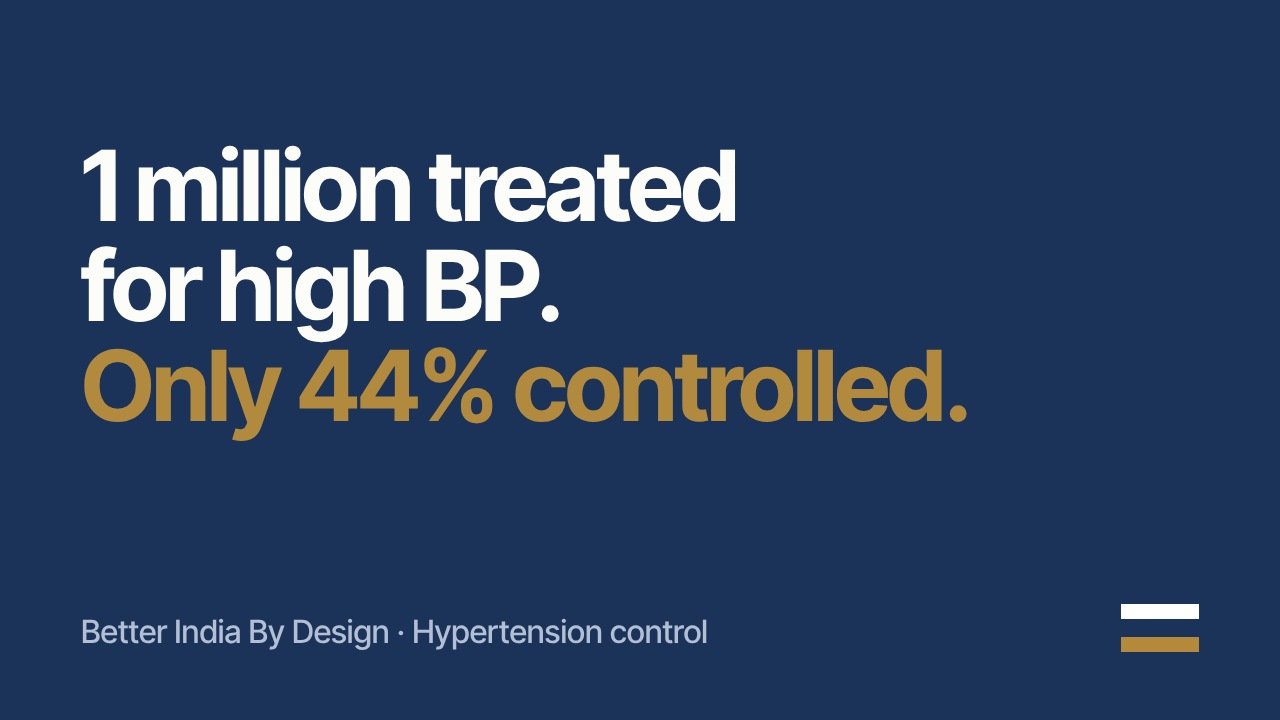
Control is another matter. In an IHCI cohort of about one million people treated in public facilities across 15 states, only 44% had their blood pressure under control. When control had to hold across two consecutive visits rather than one, the figure fell by 16 points.
The evidence
One in three patients did not come back
People started on blood pressure treatment in Punjab and Maharashtra, 2018–2021
Bars start at zero.
About a third of people started on treatment did not come back in the review quarter. Source: IHCI protocol study, medRxiv, 2023.
Source: India Hypertension Control Initiative protocol study, medRxiv, 2023. Better India By Design. See article sources →
People started on treatment in Punjab and Maharashtra, 2018–2021; return attendance is not BP-control rate. Cited medRxiv work is a preprint.
View original chart →The IHCI protocol study in Punjab and Maharashtra shows where the problem lies. Of 2,81,209 people started on treatment, 1,00,515 did not return in the review quarter. Among those who did, 70% to 76% were controlled on the first medicine alone. The protocol works. The follow-up does not.
03 · The Perspective
More is in place than most people know
- Screening and free medicine. Population screening from age 30, and protocol medicines at no cost at government health centres.
- A digital record. The Simple app and the National NCD Portal record a follow-up visit in seconds and list overdue patients.
- Doorstep care. Tamil Nadu's Makkalai Thedi Maruthuvam delivers medicine at home; state surveys found control among treated people rising from 31.4% to 43.8% over four years. Karnataka's Gruha Arogya screens at the doorstep for 14 conditions.
- Longer prescriptions are allowed. National guidance from 2020 permits up to three months' supply through ASHAs, but many facilities still dispense 5 to 15 days at a time.
04 · The Perspective
Where patients slip away
- The system acts after the miss. The overdue list names people once their medicine has already run out.
- Predictable waves go unplanned. Harvests, festivals, the monsoon and seasonal migration empty clinics at the same time every year.
- Moving means disappearing. A patient who migrates for work leaves the record behind in the village.
- Uncontrolled patients get the same prescription. Medicine is refilled unchanged even when the reading stays high.
- The wrong number is counted. Targets and incentives count people "on treatment", not people controlled.
05 · The BIBD proposal
The redesign: a Control Keeper
A design to test. Not a claim of achieved outcomes.
We propose an operating protocol on the National NCD Portal and the existing ASHA and health centre workflow.
A named keeper.
Every patient gets a keeper, usually their ASHA, whose name and number go on their BP card.
Run-out dates, not visit dates.
The system knows when each patient's medicine will run out and treats that as the deadline.
A weekly slip forecast.
Each keeper receives a short list of the 5 to 10 patients most likely to miss their next refill, so they act before the gap.
Departure supply and handover.
A patient leaving for seasonal work gets up to three months of medicine, and the health centre at the destination can see their record.
The uncontrolled-twice rule.
Two high readings in a row book a review with the medical officer for the next protocol step.
Longer refills for stable patients.
Patients controlled at two readings move to two or three month refills, freeing time for those who need it.
Sustained control as the headline.
Every centre reports the share of patients controlled at their last two readings.
06 · Design + AI
What AI can do here, and what it must not
AI is needed for one component: predicting who is about to slip, from refill history, distance, readings and the local calendar of harvests and migration. An ASHA cannot visit every patient every month; she can visit the right ten. Voice check-ins in local languages can ask whether medicine arrived.
AI must never diagnose, prescribe or change a dose, and nobody is ever denied medicine because of a score. The medical officer decides every step-up, and patient data stays within the public health system.
07 · A testable next step
Start with three blocks
A twelve-month pilot in two rural blocks with seasonal migration and one urban area that receives those migrants, with comparison blocks, can measure today's control and medicine gaps and then add keepers, forecasts and handovers. Our planning estimate is ₹1.2 to 1.8 crore, excluding medicines and existing staff.
The measures that matter are sustained control, days without medicine, step-up reviews done on time, and travelling patients re-linked on return.
08 · Who must act
What each of us can do
| People on BP medicine | never wait for tablets to run out, ask for a longer supply if you are stable, and tell your ASHA before you travel. |
|---|---|
| The Ministry of Health and state NCD cells | publish sustained control, not only people on treatment. |
| Health centres | dispense 30 days at minimum, and longer for stable patients. |
| ASHAs and community health officers | use run-out dates to plan visits. |
| Employers of migrant workers | let workers carry and refill their medicine at the work site. |
09 · The Perspective
Keep the patient, not just the prescription
India has screened, diagnosed and started treatment at a scale no other country has attempted. The next step is to keep people controlled between visits, and to count success only when blood pressure stays down.