Safety & Emergency · Cities & Environment
Episode 70 · 6 min read
India is putting panic buttons on every bus. But when hundreds of accidental alerts arrive in the same queue as one real emergency, the woman who needs help waits her turn. A better system sorts the noise, never deletes an alert, and lights the walk home.
Sources and evidence →
Perspective 69A Gas Connection Is Not a Gas KitchenBetter India By Design
Health & Care · Farming & Rural
Episode 69 · 6 min read
Ujjwala put a gas cylinder in more than ten crore poor homes. Many still cook on firewood for part of the year. The reason is not habit. It is having to find ₹942 on the day the cylinder runs out.
Sources and evidence →
Education & Careers
Episode 68 · 6 min read
Many Indian children move up a class every year without learning to read. The fix is not to hold them back. It is a floor beneath the curriculum that keeps catching them until they read on their own.
Sources and evidence →
Work & Livelihoods
Episode 67 · 6 min read
India's digital lending rules check every loan, one at a time. Nobody checks the stack, and nobody shows the borrower the total before they accept one more.
Sources and evidence →
Health & Care
Episode 66 · 6 min read
India has done the hard part of finding and treating people with high blood pressure. The system loses them in the weeks between visits, and it counts them as a success anyway.
Sources and evidence →
Safety & Emergency · Justice & Public Services
Episode 64 · 6 min read
India can find a scam victim's money within hours. Getting it back can take years, because nobody owns the step between the freeze and the refund.
Sources and evidence →
Health & Care
Episode 63 · 6 min read
India has a helpline, hundreds of treatment centres and a national campaign. What breaks is the path between them: from the first call, to safe care, to a life rebuilt.
Sources and evidence →
Safety & Emergency · Cities & Environment
Episode 62 · 6 min read
After an Indian wedding or event, the real question is not how much food is left. It is whether that food is still safe, traceable and fit to serve, and whether the people who eat it are treated with respect.
Sources and evidence →
Justice & Public Services
Episode 61 · 6 min read
India has put case status, orders and cause lists online for crores of cases. The next step is to tell the litigant, in their own language, what changed, what happens next and whose move it is.
Sources and evidence →
Justice & Public Services
Episode 60 · 6 min read
Possession, a sale agreement, an application number and a registry update are four different things. Only the last one protects the seller. A shared transfer timeline would make that visible to everyone.
Sources and evidence →
Safety & Emergency · Health & Care
Episode 59 · 6 min read
It is almost always fatal once symptoms start, and almost always preventable before they do. India has the vaccine, the law and a 2030 target. What it lacks is a chain that holds.
Sources and evidence →
Justice & Public Services
Episode 58 · 5 min read
India has built a national foundation with the Unique Disability ID. But for many people, the journey still includes unclear assessments, returned documents, renewal anxiety and a separate portal for every service that matters next.
Sources and evidence →
Work & Livelihoods
Episode 57 · 5 min read
She cooks in one home, cleans in another and cares for a child in a third. Every household sees her as part-time. So who is responsible for her leave, safety, skills or social protection? Too often, no one.
Sources and evidence →
Education & Careers · Health & Care
Episode 56 · 5 min read
A student can attend every class, submit every assignment and still be struggling. Marks, attendance and discipline matter, but they are not proof that a young person is okay.
Sources and evidence →
Work & Livelihoods · Health & Care
Episode 55 · 5 min read
A child falls ill. A parent leaves hospital. One family member quietly takes on the invisible shift: calls, travel, paperwork, supervision and lost work hours.
Sources and evidence →
Work & Livelihoods · Justice & Public Services
Episode 54 · 5 min read
Why should a worker discover a name, bank or contribution mismatch only after a provident fund claim is rejected, at the very moment they urgently need the money?
Sources and evidence →
Justice & Public Services
Episode 53 · 5 min read
Property registration should be a moment of completion. Too often, it is the moment a buyer discovers that the records do not match.
Sources and evidence →
Education & Careers
Episode 52 · 5 min read
Choose a degree, join a college, get a job. That model no longer matches the world students are entering, and families struggle to judge which colleges, courses and promises can be trusted.
Sources and evidence →
Work & Livelihoods
Episode 51 · 5 min read
A gig worker is called an independent partner. But an app decides which task appears, what it pays and how fast it must be done. Flexibility without transparency becomes invisible pressure.
Sources and evidence →
Justice & Public Services
Episode 50 · 5 min read
A ramp at the entrance cannot make a service accessible if the form, counter, queue or final document still excludes the person who needs it.
Sources and evidence →
Education & Careers · Work & Livelihoods
Episode 49 · 5 min read
India's young people are asked for experience before anyone gives them a chance to gain it. A degree or a polished résumé may look impressive. It rarely proves someone has solved a real problem.
Sources and evidence →
Cities & Environment
Episode 48 · 5 min read
A city can have parks, lakes and tree-lined roads and still not have nature that works. Isolated green spaces cannot cool neighbourhoods, support wildlife or make daily life healthier.
Sources and evidence →
Justice & Public Services
Episode 47 · 5 min read
Many government services are online now. So why do citizens still face more forms, repeat documents and a final office visit? Paperwork on a screen is not digital transformation.
Sources and evidence →
Farming & Rural
Episode 46 · 5 min read
For too many farmers, a good harvest does not mean a good year. Value leaks at every step: crop choice, advice, aggregation, storage, selling and processing.
Sources and evidence →
Education & Careers
Episode 45 · 5 min read
Students learn about problems in textbooks while real ones sit outside the school gate: unsafe water, waste, classroom heat, nutrition and road safety. What if the school worked on them?
Sources and evidence →
Cities & Environment · Justice & Public Services
Episode 44 · 5 min read
The complaint is closed. The pothole opens again next week. Drains flood again, streetlights fail again. The issue is not only slow action. It is data that lets a ticket close while the problem remains.
Sources and evidence →
Justice & Public Services
Episode 43 · 5 min read
Biometric attendance tells us who came. It does not tell us whether the service happened. An employee is present but the counter is shut; a teacher is present but the class is not taught; a doctor is present but medicines are missing.
Sources and evidence →
Cities & Environment
Episode 42 · 6 min read
Bengaluru does not lack road budgets or pothole drives. It lacks a rule that makes the agency that cuts a road pay to make it whole.
Sources and evidence →

Cities & Environment
Episode 41 · 5 min read
Millions of people need homes in Indian cities. Nearly 1 crore urban homes sit empty. Renters cannot find the right home, and owners will not release theirs. That is a trust deadlock.
Sources and evidence →
Cities & Environment
Episode 40 · 5 min read
A 72-decibel reading could come from a traffic bottleneck, honking, construction, a generator or amplified music. Each needs a different fix, and a number alone does not say which.
Sources and evidence →
Health & Care
Episode 39 · 5 min read
For the doctor, the referral is done. For the patient, the struggle has just begun: which specialist, which hospital, how urgent, which reports, and will the scheme work there?
Sources and evidence →
Health & Care
Episode 38 · 5 min read
For many patients, a confirmed appointment means: reach early, register again, wait for the doctor, then wait again for vitals, billing, reports and the pharmacy. Then come back another day.
Sources and evidence →
Safety & Emergency · Health & Care
Episode 37 · 5 min read
A medicine is trust in a small strip, bottle or box. Some are falsified, some fail quality tests, and some are recalled without the patient ever knowing.
Sources and evidence →
Farming & Rural · Safety & Emergency
Episode 36 · 5 min read
In Malnad, rain decides whether a road stays open, a school runs and a patient reaches hospital. A village experiences the monsoon as one chain, and when one link breaks, everything slows.
Sources and evidence →
Cities & Environment · Work & Livelihoods
Episode 35 · 5 min read
Indian streets are not only roads. They are workplaces, food systems and everyday markets. When the street is not designed for all of that, conflict becomes the system.
Sources and evidence →
Education & Careers · Justice & Public Services
Episode 34 · 5 min read
For a student, an exam paper is years of study and one fragile chance. When it leaks, the damage is not only cheating. Honest candidates lose time, money and faith in the system.
Sources and evidence →
Safety & Emergency · Work & Livelihoods
Episode 33 · 5 min read
Inductions that do not land, falls from height, protective gear nobody can use, heat and fatigue, a maze of subcontractors and welfare that arrives late. The worker who builds India is often the least visible person on site.
Sources and evidence →
Safety & Emergency
Episode 32 · 5 min read
The school has one clue, a CCTV camera another, a bus stand another. The police have their own process. In the first hours, the information exists. It is just not connected.
Sources and evidence →
Safety & Emergency · Cities & Environment
Episode 31 · 5 min read
A fire turns deadly when people panic, exits are blocked and the first five minutes are lost. The danger is what happens before the fire engine arrives.
Sources and evidence →

Education & Careers
Episode 30 · 5 min read
A child runs faster than everyone in school, and people clap. Then what happens? Too often, nothing does, and the talent quietly leaves sport.
Sources and evidence →

Cities & Environment
Episode 29 · 5 min read
The road from the station, the first signboard, the taxi negotiation, the toilet, the queue, the guide and the story of the place: a journey breaks when a destination is not designed as a complete experience.
Sources and evidence →
Cities & Environment
Episode 28 · 5 min read
Every Indian home has a drawer of old phones, chargers and cables, kept because they might be useful someday. That drawer holds trapped copper, lithium, resale value and personal data.
Sources and evidence →
Farming & Rural · Work & Livelihoods
Episode 27 · 5 min read
A fisher goes to sea without knowing the catch, the price or the buyer. Once the fish is landed, it has only a few hours to stay valuable, and most of the bargaining power belongs to someone else.
Sources and evidence →

Safety & Emergency · Health & Care
Episode 26 · 6 min read
After a road crash, survival depends on six links working in sequence. India has improved several of them. The breaks happen between them.
Sources and evidence →
Work & Livelihoods
Episode 25 · 5 min read
India's cities run on workers who rarely appear in the system's memory. When an accident, a wage delay or a move happens, they still have to prove who they are, where they worked and who is responsible.
Sources and evidence →
Farming & Rural · Cities & Environment
Episode 24 · 5 min read
India does not run out of water suddenly. It runs out slowly and invisibly, then all at once: a borewell fails, a tanker arrives, and the village meeting starts after the crisis.
Sources and evidence →
Safety & Emergency · Health & Care
Episode 23 · 5 min read
The milk for our children, the ghee for festivals, the spices in our kitchens. Most families have no way to know whether they are safe, and by the time a sample is tested, the food has usually been eaten.
Sources and evidence →
Cities & Environment · Justice & Public Services
Episode 22 · 5 min read
A broken tap waits for weeks, a streetlight stays dead, a toilet loses its water supply, and a small repair becomes a big failure. This is not bad luck. It is a governance design problem.
Sources and evidence →
Safety & Emergency · Work & Livelihoods
Episode 21 · 5 min read
When a sewer or septic tank blocks in India, the last resort is still too often a human body. A worker goes in without knowing the gases inside, collapses, and another goes in to save him.
Sources and evidence →

Safety & Emergency · Cities & Environment
Episode 20 · 5 min read
For some, a heatwave is a higher electricity bill. For riders, vendors, construction workers and families under tin roofs, it means lost income, sleepless nights and illness.
Sources and evidence →
Health & Care
Episode 19 · 5 min read
"Urgent blood required. Please share." In India, the search for blood still often begins with a family's phone, not with the system.
Sources and evidence →
Farming & Rural
Episode 18 · 5 min read
Cattle dung, crop residue and kitchen waste are piling up or burning in villages across India. With the right ownership and design, the same waste can produce fuel, fertiliser and local jobs.
Sources and evidence →
Cities & Environment · Justice & Public Services
Episode 17 · 5 min read
Every unconfirmed ticket tells Indian Railways exactly where, when and how many people wanted to travel. Today that information mostly turns into cancellations and refunds.
Sources and evidence →
Health & Care
Episode 16 · 5 min read
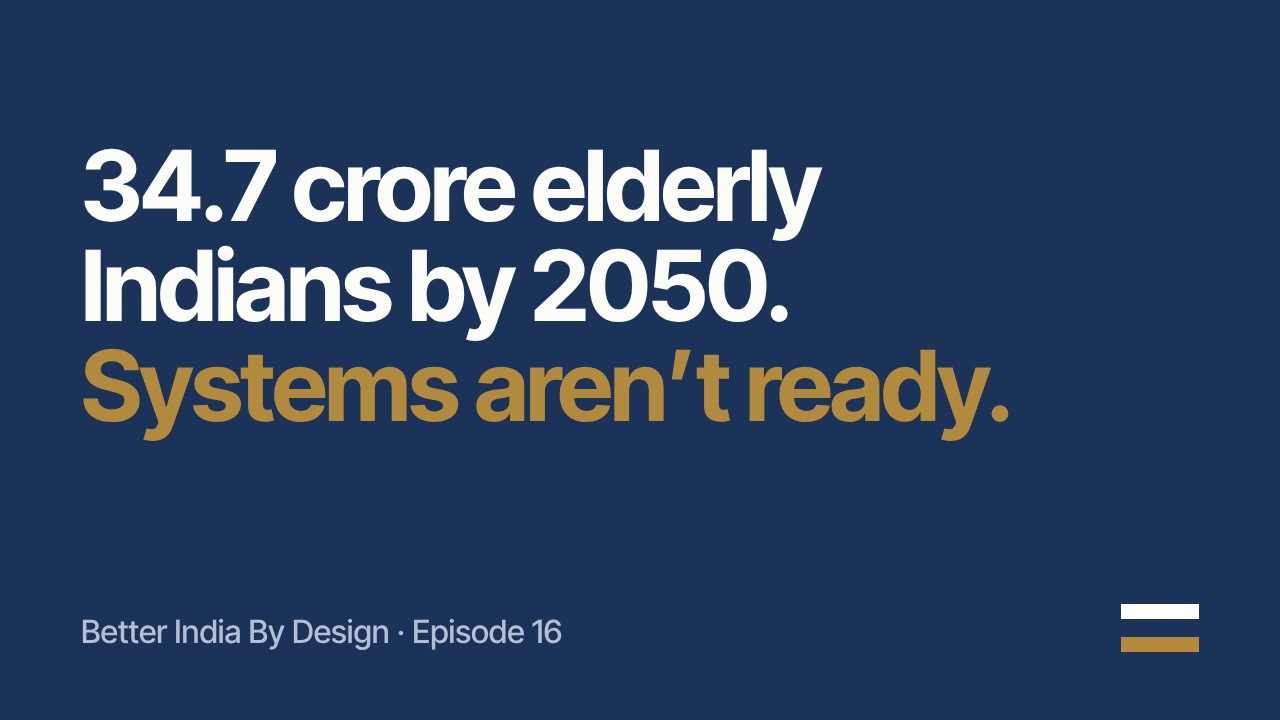
India is ageing fast. Families are smaller and more scattered, and many older people now manage health, money, technology and loneliness largely on their own.
Sources and evidence →
Work & Livelihoods
Episode 15 · 5 min read
Many Indian small businesses work harder than anyone. They stay small because their visibility, cash flow, records and customer relationships run on the owner's memory and a notebook.
Sources and evidence →
Education & Careers
Episode 13 · 5 min read
Every year, crores of Indian students sit high-stakes exams designed to sort them, not to help them learn. In an age when recall is cheap, an exam that mainly tests memory measures the wrong thing.
Sources and evidence →
Cities & Environment
Episode 12 · 5 min read
We are told traffic comes from too many cars and that wider roads are the cure. Decades of evidence say wider roads fill up again. The real problem is that public transport is too unreliable to beat the car.
Sources and evidence →
Farming & Rural
Episode 11 · 5 min read
Indian farmers take the weather risk, the price risk and the debt. Between their field and the plate, much of the value leaks away to spoilage, opaque prices and long chains of middlemen.
Sources and evidence →
Justice & Public Services
Episode 10 · 5 min read
For many Indians, going to court means years of dates, adjournments and travel before anything is decided. The backlog is usually blamed on too few judges. Much of it is a problem of how the work is organised.
Sources and evidence →

Justice & Public Services
Episode 9 · 5 min read
A delayed permit, a missing signature, a trip from one office to another. We call it "the way things are". It is really a design failure that turns citizens into couriers for the government's own files.
Sources and evidence →
Cities & Environment
Episode 8 · 5 min read
Every Environment Day, people are told to feel guilty. But you cannot expect green choices when the systems around people are built for friction and waste. Sustainability belongs in the design.
Sources and evidence →
Work & Livelihoods
Episode 7 · 5 min read
We celebrate our weavers on national holidays and buy their work out of goodwill. Meanwhile, most of them earn less than a minimum wage, because the system around the craft was never designed to pay for its value.
Sources and evidence →
Health & Care
Episode 5 · 5 min read
India has world-class doctors and medicine. Patients still leave many hospitals confused, anxious and unheard, because the journey around the treatment was never designed.
Sources and evidence →
Design + AI Mindset · Education & Careers
Episode 4 · 5 min read
Indian schooling still rewards memory and obedience. In a world where AI can produce an answer in seconds, the scarce skills are knowing what to ask, judging what comes back and learning from failure.
Sources and evidence →