01 · The Perspective
Another date
The story below is illustrative. It is not about a real person.
A small shopkeeper files a case to recover ₹2 lakh owed by a supplier. On the first date, the other side asks for time. On the second, the file is incomplete. On the third, the judge is on leave. Each visit costs him a day's business and a lawyer's fee.
Four years later the case has been listed 31 times. The amount at stake is now smaller than what he has spent. The process has become the punishment.
02 · The Perspective
The size of the backlog
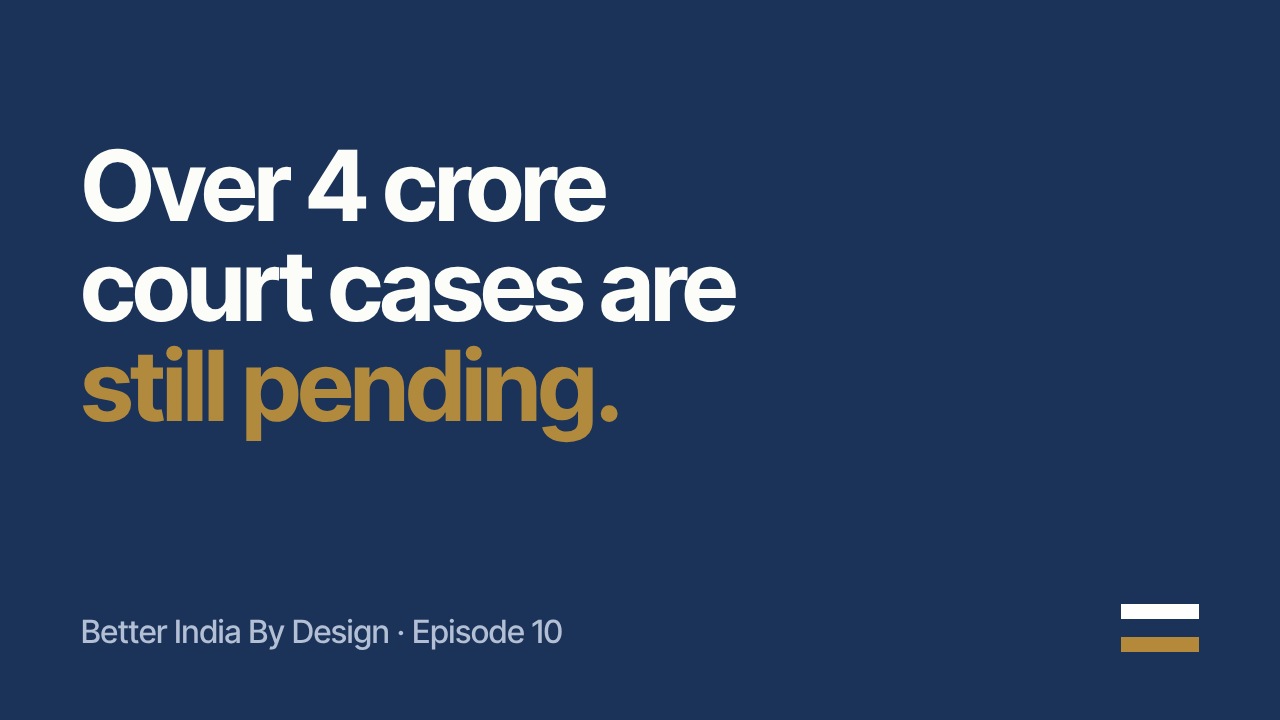
According to figures from the National Judicial Data Grid given to the Rajya Sabha in July 2026, more than 5.64 crore cases were pending across India's courts. Over 10,000 cases in the Supreme Court had waited more than a decade.
The breakdown shows where the pressure is. On 31 December 2025, 4.76 crore cases were pending in district and subordinate courts, 63.66 lakh in the High Courts and 92,101 in the Supreme Court.
The evidence
Most of the backlog sits in district courts
Cases pending in Indian courts, 31 December 2025
Bars start at zero.
The backlog is overwhelmingly in district courts. Source: NJDG, Lok Sabha reply of 13 February 2026, via IANS.
Source: National Judicial Data Grid, Lok Sabha reply of 13 February 2026, via IANS. Better India By Design. See article sources →
Snapshot dated 31 December 2025; use crore/lakh/unit conversion before drawing comparable bars.
View original chart →03 · The Perspective
More is in place than most litigants know
- Open data. The National Judicial Data Grid publishes pendency for every court, updated continuously.
- eCourts. Case status, cause lists and orders are online, and many courts hold hearings by video.
- Virtual courts. Traffic challans in many states are handled online, without a court visit.
- Lok Adalats. National Lok Adalats settle lakhs of cases by agreement in a single day.
The building blocks for faster justice exist. The way cases move through them has not been redesigned.
04 · The Perspective
Where the time goes
- Adjournment loops. Cases are listed without being ready, so hearings end in a new date.
- Overloaded cause lists. Judges are given more cases a day than can be heard, so many are simply adjourned.
- Paper-heavy files. Judges and staff spend hours reading long files to find the key facts.
- Small disputes in full courts. Cases that could be settled quickly occupy the same queue as complex ones.
- Citizens in the dark. Litigants rarely understand why their case was adjourned or what happens next.
05 · The BIBD proposal
The redesign: three blueprints
A design to test. Not a claim of achieved outcomes.
Smarter scheduling.
List a case only when it is ready, with documents filed and parties confirmed. Give each case a realistic slot rather than listing far more than can be heard.
A judicial co-pilot.
AI prepares a short, sourced summary of each file, with key dates, claims and documents, so the judge can start from the substance.
Online resolution for small claims.
Money disputes below a threshold go first to an online process with mediation, so only the unresolved reach a courtroom.
Clarity for citizens.
Every litigant receives a plain-language explanation of each hearing and the next step, in their language.
06 · Design + AI
Where AI helps, and where judges decide
AI can summarise long case files, flag missing documents before a hearing, predict which listed cases are likely to be adjourned and draft plain-language updates for litigants.
Judges decide every case. AI summaries always link back to the original pages, and nothing produced by AI is treated as evidence or as a finding.
07 · A testable next step
Start with one district court
One district court can run a twelve-month pilot: readiness checks before listing, AI-prepared summaries for one category of civil case, and an online route for small money claims. Our planning estimate is ₹1 to 2 crore.
The measures that matter are adjournments per case, days from filing to disposal, the share of listed cases actually heard, and litigants who understood their next step.
08 · Who must act
What each of us can do
| The Department of Justice and the Supreme Court eCommittee | publish adjournment rates by court, not only pendency. |
|---|---|
| High Courts | pilot readiness-based listing in a few districts. |
| Bar Councils | support limits on repeated adjournment requests. |
| Legal-tech builders | build tools for case summaries and status that work in Indian languages. |
| Citizens | check your case on the eCourts portal, and ask your lawyer why each adjournment happened. |
09 · The Perspective
Justice that arrives in time
India's courts handle more cases than almost any system on earth. Judges cannot be multiplied overnight, but the time they already have can be used far better. Redesign the process, and fewer citizens will find that the process itself is the punishment.