01 · The Perspective
A call, a freeze, then silence
The story below is illustrative, built from the process described in our sources. It is not about a real person.
A retired teacher receives a video call from a man in a police uniform. He is told he is under "digital arrest" and must transfer his savings to "verify" them. Over two days he sends ₹8 lakh. When his son finds out, they call 1930 within hours.
The system works at first. About ₹3 lakh is frozen across three accounts in two other states. Then nothing happens. The family is told they need a court order, but not which court or what to file. The frozen accounts also hold money from other victims, so the bank will not release anything until someone decides who gets what.
He did everything right. The system found his money. It never gave it back.
02 · The Perspective
Three per cent comes home
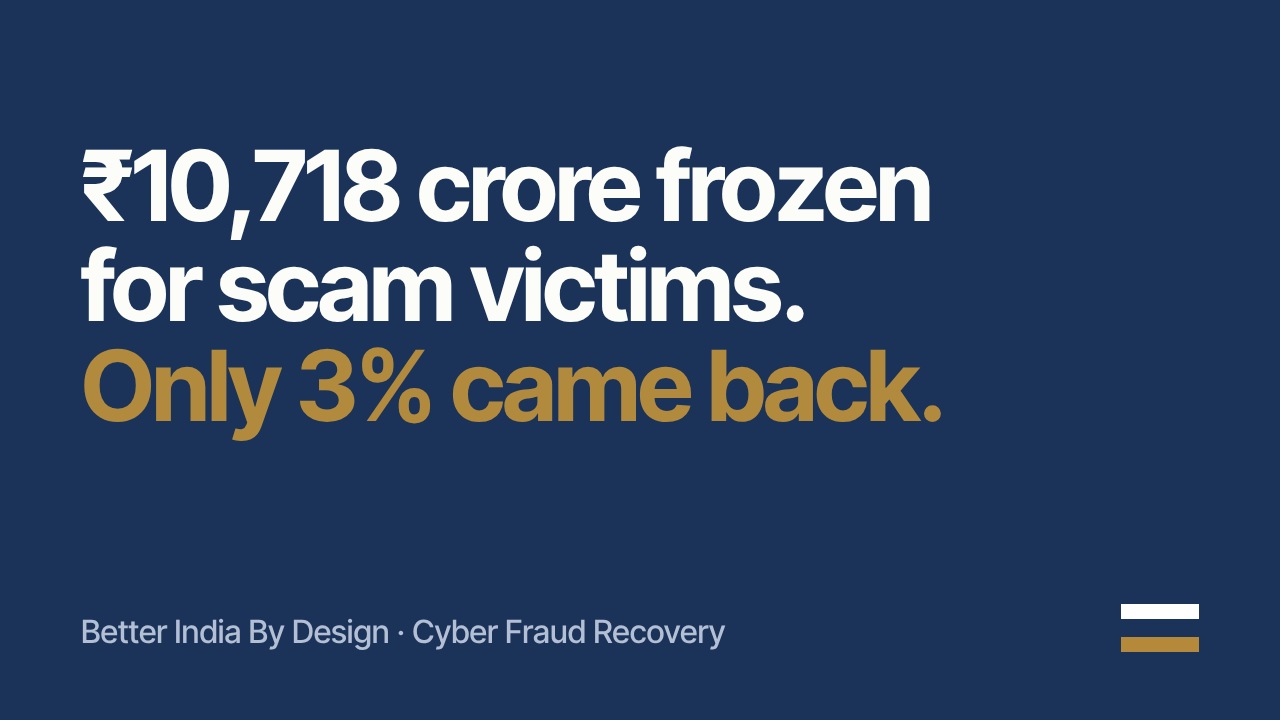
According to Ministry of Home Affairs review data reported in July 2026, Indians reported losing about ₹64,447 crore to financial cyber fraud between 2021 and May 2026. About ₹10,718 crore was frozen. About ₹323 crore was refunded.
The evidence
Found is not the same as returned
Financial cyber fraud in India, 2021 to May 2026 (₹ crore)
Bars start at zero.
Of the money frozen for victims, about 3% had come back. Source: MHA review data, reported July 2026.
Source: Ministry of Home Affairs review data, reported July 2026. Better India By Design. See article sources →
Reported losses, frozen balances and refunds are nested stages, not additive totals; date range 2021–May 2026.
View original chart →The pace is rising. In the first six months of 2026 alone, 12.71 lakh complaints reported losses of about ₹10,179 crore, roughly ₹56 crore a day.
The headline number the government publishes is money "saved", which means frozen or held. A Rajya Sabha reply in August 2026 put it at over ₹11,158 crore. That is a real achievement. But saved is not returned, and no regularly published figure tracks money refunded or the time it takes.
03 · The Perspective
More is in place than most victims know
- One number and one portal. The 1930 helpline and cybercrime.gov.in route complaints to the victim's bank and the receiving bank, which can place a hold before the money is withdrawn.
- Refunds without court for small frauds. An MHA standard operating procedure of January 2026 allows refunds under ₹50,000 without a court order, limits holds to the disputed sum and, for these smaller frauds, lifts freezes after 90 days if no court order follows.
- A restoration module. A Money Restoration Module on the national portal has been functional since April 2026.
- New bank liability rules. RBI rules applying from 1 January 2027 put the burden of proving customer negligence on the bank and set a 45-day resolution window.
Abroad, the UK has required banks to reimburse victims of authorised push payment scams since October 2024, with the sending and receiving banks sharing the cost. In its first year, 88% of money lost was reimbursed.
04 · The Perspective
Where the money gets stuck
- Shared accounts. One mule account can hold money from victims in several states. Deciding who gets what needs a reconciliation nobody prepares.
- Undecidable cases. Above ₹50,000, a victim needs a court order, and the court receives an application with no tracing trail and no proposed split.
- Holds without owners. A freeze has no named officer and no deadline, so it can last indefinitely.
- Innocent account holders. Legal commentators report freezes with no notice and no clear route to contest them, which makes banks and courts cautious.
- The wrong number is counted. The system measures what it stops, not what it gives back.
05 · The BIBD proposal
The redesign: a Restitution Track
A design to test. Not a claim of achieved outcomes.
We propose an operating protocol on top of the national portal and the Money Restoration Module. It does not change who decides. It makes every case ready to decide.
One restitution ID per victim.
Status by SMS, phone or portal: how much is frozen, where, the current step, its owner and the next deadline.
Every hold has an owner and a clock.
Holds that miss their deadline escalate to the district, then the state.
Distribution schedules before court.
A District Restitution Officer prepares a proposed pro-rata split for every multi-victim account, shared with claimants, who can object.
Batch restitution hearings.
District courts consider ready schedules together, with pre-filled applications, so victims need no lawyer.
Digital orders, value-dated refunds.
Orders reach banks on the same rails that carried the freeze.
A fast lane for innocent holders.
Notice within 48 hours, only the disputed amount held, and a contest route with a deadline.
A published returned rate.
Money returned, by state, every quarter.
06 · Design + AI
What AI can do here, and what it must not
AI can trace money across layers of accounts, match frozen balances to the complaints that fed them, draft distribution schedules and send status updates in Indian languages. Manual reconciliation at lakhs of complaints is not feasible. This is the step where AI earns its place.
It must never freeze or release money, or decide who is a victim and who is a fraudster. A named officer reviews every schedule, the court decides, and every schedule shows its tracing trail so anyone can check it.
07 · A testable next step
Start with three districts
A twelve-month pilot in one state, with three districts, five to eight banks, the district courts and the state legal services authority, can begin by counting today's frozen money, refunds and days to refund, then run monthly batch hearings. Our planning estimate is ₹1 to 1.5 crore, excluding police salaries.
The measures that matter are the share of frozen money returned, median days from freeze to refund, holds past their deadline, and how many victims needed a lawyer.
08 · Who must act
What each of us can do
| Citizens | report to 1930 at once, keep your complaint number and ask for the refund status, not only the freeze status. |
|---|---|
| I4C and the Ministry of Home Affairs | publish money returned to victims alongside money saved, every quarter. |
| State cyber crime cells | name a restitution officer in each district. |
| District courts and legal services authorities | pilot one monthly batch restitution hearing. |
| RBI and banks | require freeze notices within 48 hours and release within a fixed time of a digital order. |
09 · The Perspective
A rupee found should come home
India built a system that can find a victim's money within hours. It has not yet built the system that gives it back. Report once, track every rupee, prepare the case, decide in batches and publish what comes back.