01 · The Perspective
"Purpose: For Steps"
The story below is illustrative, built from the process described in our sources. It is not about a real person.
A woman filed a boundary dispute in a district court three years ago. Her son checks the eCourts app every few weeks. It says: "Next date: 14-11-2026. Purpose: For Steps."
Neither of them knows what that means. Is she meant to do something? Did the other side? The lawyer is hard to reach. A man outside the court offers to "find out" for ₹500. On the hearing day she takes leave, travels two hours and waits until the afternoon, only for the matter to be adjourned in a minute.
The information was online all along. It just was not usable.
02 · The Perspective
Fifty listed, six heard
As of 31 December 2025, more than 5.41 crore cases were pending across Indian courts, about 4.77 crore of them in district and subordinate courts, according to the Law Ministry's reply in the Lok Sabha.
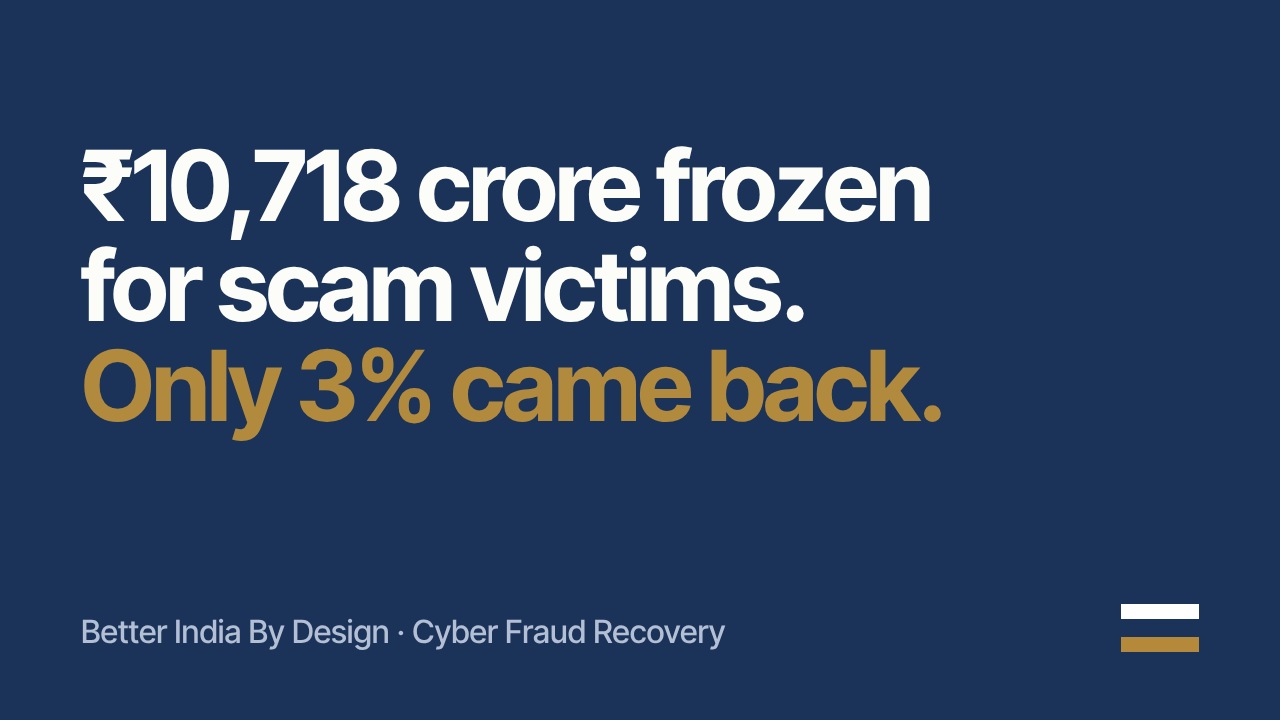
A litigant who travels for a hearing is far more likely to see an adjournment than an argument. A DAKSH time-and-motion study of four trial courts found that about 50 cases were listed on an average day and only about 6 were heard, and that adjournments took about half of civil courts' sitting time.
The evidence
Most listed cases are not heard on the day
Cases on an average day's cause list in four trial courts
Bars start at zero.
Most cases on a day's cause list are not heard. Source: DAKSH, Time and Motion Study of Four District and Sessions Courts.
DAKSH, Time and Motion Study of Four District and Sessions Courts. See article sources →
Four-court study; not a national daily total.
View original chart →The courts already record why cases stall. The National Judicial Data Grid showed more than 66 lakh district court cases delayed where the recorded reason was that lawyers were unavailable. The data needed to explain a case is partly coded already. It is just not explained to the litigant.
03 · The Perspective
What India has already built
- eCourts services. Case status, orders and cause lists by app, SMS, email and kiosk. The eCourts app has 3.84 crore downloads, and more than 4 lakh SMSs and 6 lakh emails go out every day.
- eSewa Kendras. 2,584 help centres in court complexes, as of June 2026.
- Translation. More than 83,000 judgments translated into 18 Indian languages.
- Free legal aid. About 44 lakh people received legal aid and advice between 2022–23 and 2024–25.
- AI legal information. In March 2026 the Department of Justice launched Nyaya Setu, a chatbot that answers legal questions in 22 Indian languages.
04 · The Perspective
Why the screen still confuses
"Awaiting Service Report" means the court is waiting to confirm that the other side received notice. "For Steps" usually means a party must take a procedural step, such as paying process fees. Labels vary between states. Orders are long and often in English.
Nothing on the screen says what changed since your last hearing, whose move it is or where to get free help. People fill the gap with phone calls, visits and intermediaries. Nobody publishes whether litigants actually understand where they stand.
05 · The BIBD proposal
Nyaya Path: a meaning layer for every case
A design to test. Not a claim of achieved outcomes.
We propose a plain-language layer on top of official eCourts data:
An approved status dictionary.
Each High Court maps its local labels to plain meanings, tested with first-time litigants and approved by judges and court staff. The original label always appears beside it.
What changed since your last hearing.
A short card built from official entries, each line linked to its source.
Whose move it is.
A marker: the court, your side, the other side, or not yet known. "Your side" always adds: "Speak to your advocate or the legal services authority."
The order in brief.
For new orders, the operative line quoted exactly, with a labelled plain-language explanation. The court's order stays the only official version.
Hearing-day help.
The hall, the cause-list number, the video link where used, and what the order says about attendance.
Free help on every page.
The nearest eSewa Kendra, the District Legal Services Authority, Tele-Law (14454) and Nyaya Setu, with a call-back request.
06 · Design + AI
What AI can do here, and what it must not
AI can translate approved meanings and summaries into Indian languages, read them aloud, assemble the "what changed" card and find the operative line of an order.
It must never give legal advice, predict outcomes or timing, or profile judges and lawyers. Status meanings come from the human-approved dictionary, not free generation, and every summary links to the official record. Courts have rightly barred AI from judicial decisions; the Kerala High Court's 2025 policy is one example. Case data should be processed only on government infrastructure.
07 · A testable next step
Start with two High Courts
A nine-month pilot in district courts under two High Courts, one Hindi-speaking and one not, can begin with the 50 most common status labels, then add the "what changed" card and the help routes at eSewa Kendras, and finally order summaries and voice. Our planning estimate is ₹2 to 4 crore.
The measures that matter are whether litigants can correctly say what happens next, hearings missed by parties, routine status queries to court staff, and referrals to free legal aid.
08 · Who must act
What each of us can do
| Litigants | use the free eSewa Kendra at your court complex, and ask your lawyer whose move it is. |
|---|---|
| The eCommittee of the Supreme Court | adopt a national plain-language status dictionary. |
| High Courts | map your local labels and test them with people who have never been to court. |
| The Department of Justice | fund the layer within eCourts Phase III and link Nyaya Setu to the case page. |
| NALSA and the legal services authorities | put a call-back route on every case page. |
09 · The Perspective
Speak the litigant's language
India has already put its courts online. The next step is to make the record speak the litigant's language. Clarity will not shorten every case, but it will stop people losing hearings, money and trust to confusion.