01 · The Perspective
A slip of paper and a long bus ride
The story below is illustrative. It is not about a real person.
A farmer visits his taluk hospital with chest pain. The doctor suspects a heart problem and refers him to a district hospital. He travels two hours with his son. At the district hospital, the cardiologist is on leave. He is referred again, to a city hospital 150 kilometres away.
At the city hospital, the staff ask for reports he did not bring and question whether his scheme covers the procedure. Nobody at the taluk hospital ever learns what happened to him.
02 · The Perspective
What the data shows
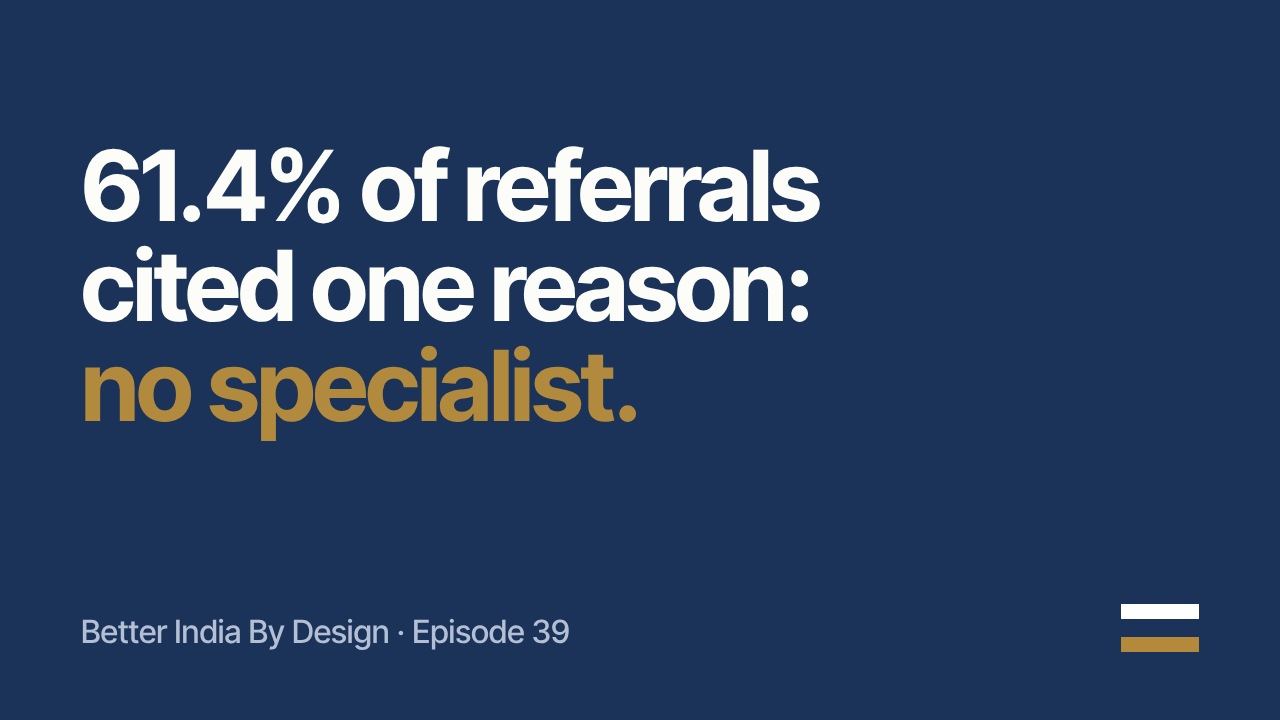
The World Health Organization's 2025 study, The Online Referral System in the state health insurance scheme of Karnataka, analysed referral reasons from 2018 to January 2024. Of 1,37,906 referrals, 61.4% cited "specialist not available". Staff estimated that only about 3,000 of every 10,000 referrals could be linked to claims records.
Karnataka is one of the few states that records referrals online at all. That is why its data is so valuable, and why it shows the gap so clearly.
03 · The Perspective
More is in place than most patients know
- Ayushman Bharat PM-JAY and state schemes. Cover hospital treatment for eligible families, including referrals.
- Karnataka's online referral system. Records referrals digitally within the state scheme.
- ABDM. Health IDs and records that can travel with patients across hospitals.
- eSanjeevani. Teleconsultation that can connect patients to specialists remotely.
04 · The Perspective
Where the loop breaks
- Referrals go to places without the specialist, so patients are sent on again.
- Urgency is unclear, and patients do not know how quickly to go.
- Records do not travel, so tests are repeated.
- Scheme eligibility is checked late, at the receiving hospital.
- The loop never closes. The referring doctor rarely learns the outcome.
05 · The BIBD proposal
The redesign: a Referral Continuity OS
A design to test. Not a claim of achieved outcomes.
Referrals matched to verified specialist availability, so the patient goes where care is actually available.
Clear urgency and next steps, in the patient's language.
Records travel with the patient through ABDM.
Scheme eligibility checked upfront, before the patient travels.
The loop closes back to the referring doctor, with the outcome recorded.
06 · Design + AI
Where AI helps, and where doctors decide
AI can match referrals to hospitals with available specialists and capacity, track whether patients complete referrals and flag those who drop out.
Clinical decisions, including urgency and where to refer, stay with doctors.
07 · A testable next step
Start with one district network
One district, with its primary health centres, taluk hospitals, district hospital and empanelled private hospitals, can pilot the system for a year. Our planning estimate is ₹60 lakh to ₹1 crore.
The measures that matter are referrals completed, referrals sent on a second time, days from referral to treatment and referring doctors informed of outcomes.
08 · Who must act
What each of us can do
| Patients | carry all reports and ask the referring doctor to confirm the specialist is available. |
|---|---|
| The National Health Authority | build referral tracking into PM-JAY and ABDM. |
| State health departments | publish live specialist availability by hospital. |
| Hospitals | confirm receipt of referrals and report outcomes back. |
| Doctors | follow up on the patients you refer. |
09 · The Perspective
Closing the loop
A referral should be the start of the next step in care, not the start of a search. When the system tracks the patient to treatment, the burden comes off the family.