01 · The Perspective
A flat, a phone and a long afternoon
The story below is illustrative. It is not about a real person.
A retired bank officer lives alone after his wife's death. His son works in another country, his daughter in another city. He has three doctors, none of whom see each other's notes. He keeps his medicines in a shoebox.
A caller tells him his pension will stop unless he updates his details online. He nearly shares a one-time password before a neighbour stops him. Most days, the only conversation he has is with the vegetable seller.
Nothing in his life is an emergency. That is why no system notices him.
02 · The Perspective
The shape of the next 25 years
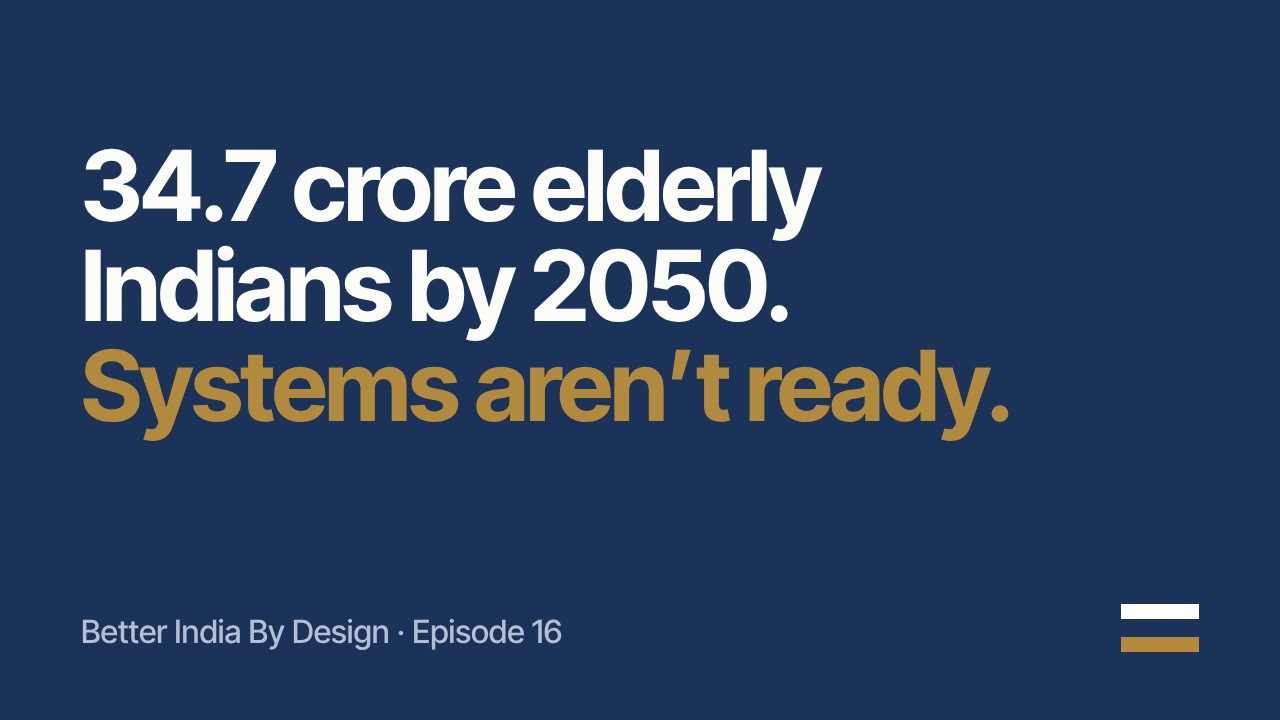
The UNFPA's India Ageing Report 2023 projects that India's population aged 60 and above will rise from 10.5% in 2022 to 20.8% by 2050, about 34.7 crore people. It expects older people to outnumber children aged up to 14 by around 2046.
The evidence
India’s older population will double its share
People aged 60 and above, share of India’s population
Bars start at zero.
India's population aged 60 and above, share of total. Source: UNFPA India Ageing Report 2023, as reported by The National.
Source: UNFPA India Ageing Report 2023, via The National. Better India By Design. See article sources →
2050 is a projection, not an observed result.
View original chart →That is a larger elderly population than most countries have people. The question is not whether India will care for them, but whether the care will be designed or improvised.
03 · The Perspective
More is in place than most families know
- A national helpline. Elderline, 14567, offers information, guidance, emotional support and help in cases of abuse.
- Legal protection. The Maintenance and Welfare of Parents and Senior Citizens Act, 2007 gives older people a legal claim to maintenance and protection.
- Health cover. Ayushman Bharat PM-JAY has been extended to cover people aged 70 and above, regardless of income.
- Pensions and savings schemes. National old-age pensions and senior citizens' savings schemes exist, though amounts and awareness vary widely.
04 · The Perspective
Where the system breaks
- Fragmented care. Specialists, pharmacies and labs do not share a record, and nobody owns the whole picture.
- Loneliness is invisible. It is not counted, so it is not served.
- Money and fraud. Pension paperwork, insurance claims and scam calls all land on the person least equipped to handle them alone.
- Technology built for the young. Small text, fast timeouts and one-time passwords exclude many older users.
- Homes and streets. Broken pavements, high steps and no seating keep older people indoors.
05 · The BIBD proposal
The redesign: a Dignity OS
A design to test. Not a claim of achieved outcomes.
Continuous care.
One shared, consent-based health record and a named care coordinator, linked to ABDM, for every older person who wants one.
Companionship as a service.
Neighbourhood volunteers, day centres and regular check-in calls, tracked like any other public service.
Money and safety help.
A trusted local point for pensions, insurance and scam reports, with a simple way to pause suspicious transactions.
Elder-friendly technology.
Larger text, voice-first options, longer timeouts and assisted modes as a standard for public digital services.
Age-friendly homes and streets.
Ramps, rails, seating and safe crossings, starting with the streets near hospitals, markets and parks.
06 · Design + AI
Where AI helps, and where people decide
AI can remind people about medicines, flag missed check-ins or sudden changes in routine, detect likely scam calls and offer voice assistants in Indian languages.
It must not replace human company or make care decisions alone. Older people and their chosen family decide what is monitored and who sees it.
07 · A testable next step
Start with one ward
One urban ward and one rural block, working with the local body, a hospital, a senior citizens' association and volunteers, can pilot the Dignity OS for twelve months. Our planning estimate is ₹60 to 90 lakh.
The measures that matter are older people with a named coordinator, emergency hospital visits, reported loneliness, scam losses, and how many older people go out each week.
08 · Who must act
What each of us can do
| Families | save 14567 in your parents' phones and agree on one person who holds the full picture of their care. |
|---|---|
| Municipalities | audit the streets around hospitals and markets for older walkers. |
| Hospitals | name a geriatric care coordinator. |
| Banks and app makers | test every service with users over 70 before launch. |
| Residents' associations | start a weekly check-in for older residents who live alone. |
09 · The Perspective
A country that ages well
Ageing is not a crisis. It is a success: people are living longer. Whether those years are lived with dignity depends on design choices India makes now, while there is still time to make them.