01 · The Perspective
A credit of a few rupees
The story below is illustrative, built from the patterns in our sources. It is not about a real person.
Prakash grows soybean on four acres in Akola district, insured through his crop loan. In September, heavy rain flattened his crop just before harvest. He spent three days trying to reach the insurer within the 72-hour window, and was promised a survey that never came.
In November his phone showed a credit of ₹14, with no explanation. At the agriculture office he was told the payout followed the "average yield of the area".
Prakash was insured. He was not paid.
02 · The Perspective
A vast scheme, a tiny payout
The Pradhan Mantri Fasal Bima Yojana is enormous. Since Kharif 2016, more than 92.46 crore farmer applications have been insured, and over 26.33 crore have been paid claims worth more than ₹2.06 lakh crore. In 2024-25 the scheme covered more than 4 crore farmers, and the Centre has allocated ₹12,200 crore for 2026-27.
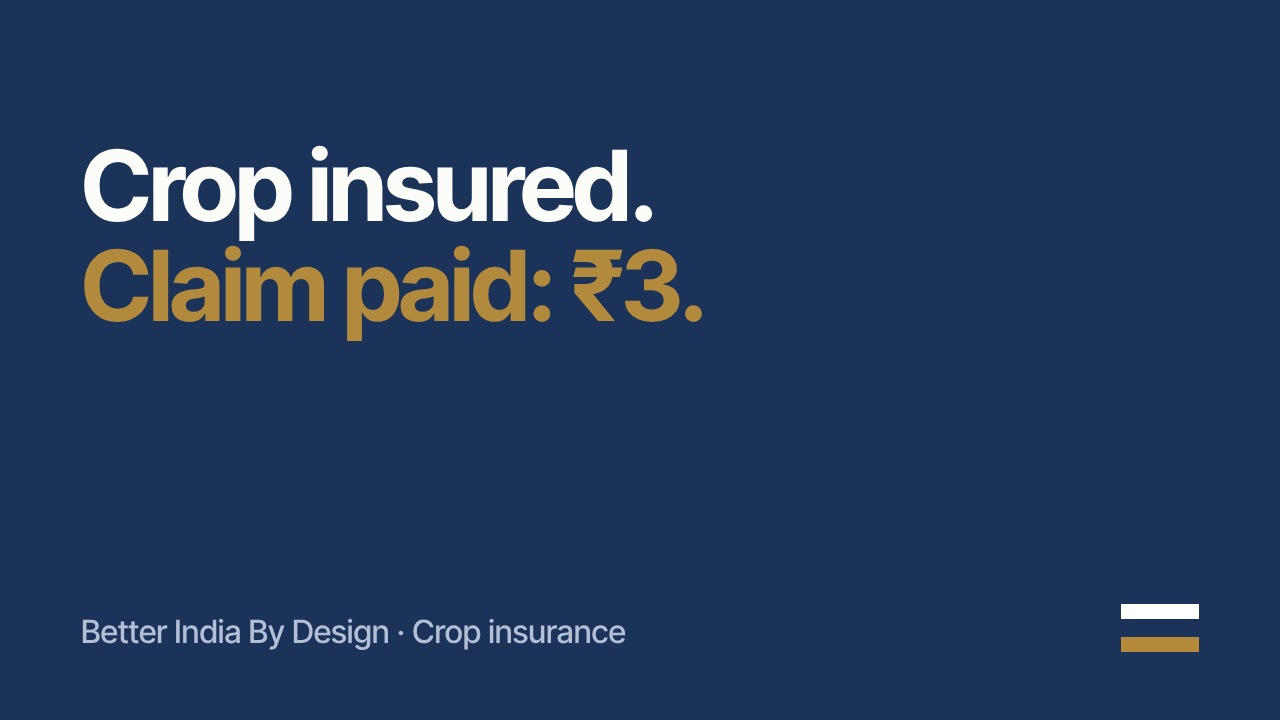
The farmer's experience can be very different. In October 2025, farmers in some villages of Akola district, Maharashtra, said they had received as little as ₹3 and ₹21 for soybean, cotton and moong lost to heavy rain. They protested at the district collector's office and returned the money by cheque. Days later the Union Agriculture Minister ordered a nationwide probe after reports of payouts as low as ₹1, ₹2 or ₹3.
In Solapur, a farmer whose pigeon pea was destroyed by the 2024 heatwave received ₹6,670. He says the crop would have fetched ₹70,000 to ₹80,000.
Across the scheme, the gap between premium and claims has widened. In 2024, ₹12,557 crore was paid in claims against ₹26,772 crore in premium. Rural Voice, which compiled the data, notes the difference is not insurers' profit, since they also bear operating and other expenses.
The evidence
Under ₹70 in claims for every ₹100 of premium
PMFBY claims paid per ₹100 of total premium (farmers, states and Centre), 2020 to 2024
Since 2020, less than ₹70 has been paid in claims for every ₹100 of premium. Source: PMFBY portal data to 30 June 2026, compiled by Rural Voice (2 July 2026). See article sources →
Rural Voice notes the gap is not insurers' profit, since they also bear operating and other expenses.
View original chart →03 · The Perspective
What India has already built
- YES-TECH and WINDS. Satellite-based yield estimation and a weather-station network, which the Ministry says enable faster, fairer and more transparent claim settlement.
- CROPIC. Geo-tagged crop photographs to check crop health in an insurance unit, with nationwide pilots for damage assessment.
- Digiclaim. Since Kharif 2022, claims are calculated on the national portal and paid through the Public Finance Management System.
- Helpline 14447. The Krishi Rakshak Portal and Helpline, launched in January 2024, for grievances and tracking.
- A penalty for delay. Insurers and states that delay payouts now face a 12% penalty.
04 · The Perspective
The step nobody owns
The trouble is the design of the claim, not the lack of data.
PMFBY mainly follows an area approach. As the head of IFFCO-Tokio told Rural Voice, claims are decided "by looking at the average crop yield of a notified Insurance Unit rather than measuring losses in every individual farmer's field." If one field is destroyed and the area's average survives, the loss shrinks to a few rupees.
A farmer can claim for a local loss, but the clock is short. "Localized claims must be reported within 72 hours of the event," an insurance executive told the same report. "Late reporting results in automatic rejection." The scheme's operational guidelines do allow later notice, up to the harvest date, for some local calamities such as hailstorm, inundation and cloudburst, when supported by weather data or official reports.
And the money arrives without a reason. The farmer is not told the threshold yield, the actual yield of her area, or how her payout was worked out, and she has no simple way to ask for a second look.
The satellites, weather stations and photos already exist. Nobody uses them to put each farmer's loss on record before she has to prove it.
05 · The BIBD proposal
Proof to Payout
A design to test. Not a claim of achieved outcomes.
We propose Proof to Payout, a farmer-facing layer on top of the national portal, YES-TECH, WINDS, CROPIC, Digiclaim and the helpline. It does not replace the scheme.
My Field Record.
Every insured plot gets a season-long file, filled with satellite readings, nearby weather data and crop photos, taken by the farmer or a village helper.
Claims that open on their own.
When weather stations or satellites show a hailstorm, flood or heavy rain over a gram panchayat, the system opens a "possible loss" record for every insured plot in that area. That counts as timely notice, so no one loses a claim to the 72-hour clock.
Gap Review before credit.
Payouts below a set amount, such as ₹1,000, or far below the loss in the field record, are checked by a district committee before they are paid.
Every rupee explained.
Each payout comes with a voice message and SMS in the farmer's language: the threshold yield, the actual yield, her sum insured and the result, with a one-step request for a second look.
A Claim Clock.
Each claim shows its stage, who holds it and since when. When an insurer is late, the 12% penalty is shown and paid automatically.
A Paid Fairly Index.
Each district publishes, by season, insurer and crop: insured losses paid, days from loss to money, payouts below ₹1,000, rejections by reason, and second looks answered.
06 · Design + AI
What AI can do here, and what it must not
AI can map where a calamity struck, flag payouts far below a plot's recorded loss, and turn a payout calculation into a plain voice message.
It must never reject a claim, cut a payout or decide who gets a survey on its own. Field records belong to the farmer and must never be used to score her for loans. People decide.
07 · A testable next step
Start with one district
A pilot over one Kharif and one Rabi season in Akola district, compared with a similar district, can test the whole journey. Our planning estimate is ₹3 to 5 crore for 18 months, excluding premiums and claims.
The measures that matter are the share of insured losses that were paid, the median days from loss to money, the number of payouts below ₹1,000 and how many were reviewed, and how many second looks were answered on time.
08 · Who must act
What each of us can do
| Farmers and families: | if you receive a payout that makes no sense, ask for the calculation on helpline 14447. |
|---|---|
| The PMFBY team at the Ministry of Agriculture: | pilot auto-opened claims and the Payout Explainer on the national portal. |
| State agriculture departments: | publish payouts below ₹1,000 and the days from loss to money, by district. |
| Insurers: | review tiny payouts against field evidence before they are credited. |
| District collectors: | chair a claims committee that reviews the Paid Fairly Index every season. |
09 · The Perspective
Insured should mean paid
India has built the hardest parts: a scheme that reaches crores of farmers, and the satellites, weather stations and apps to see what happens on the ground. The next step is to point them at the farmer, not just the area. Insured should mean paid.
Watch the full episode: Redesigning Crop Insurance in India: Insured Is Not Paid